



This post has been written for the theme “26 Places, 26 Memories” for the #AtoZChallenge.
X FOR XI’AN:
Xi’an is the capital of the Shaanxi Province in central China. This large city has been the chosen capital of multiple Chinese dynasties. The real draw of the place, however, is its fascinating Terracotta Army or Bingmayong.
Local farmers in the area, discovered life-sized terracotta figurines buried underground, while digging the land in 1974. Slowly, archaeological sites in Xi’an’s surrounding plains uncovered thousands of life-sized, hand-moulded figures buried with China’s first emperor, Qin Shi Huang.
I visited Xi’an on a trip to China with my family and close family friends, in April 2009. We covered Beijing and Shanghai and spent a night in Xi’an. China is a cultural experience beyond anything you’ve imagined. It was like being transported to a different world. Though the entire trip was memorable, this visit really stood out.
‘XCEPTIONAL ‘XHIBITS AT XI’AN:
The grimy streets and crowded by lanes of Xi’an were so unlike the orchestrated sparkle of Beijing and the slickness of Shanghai; that even our short visit seemed too much when we arrived. It was like walking through Daryaganj in Delhi- not for the faint of heart!
The archaeological site had long lines of tourists patiently waiting to buy tickets, and the large crowds added to my irritability. However, when we finally entered after navigating the serpentine queue, I was completely blown away.
There were rows upon rows of massive statues of men in full military dress holding weapons. Each statue was life-sized and completely life-like; with unique expressions, some angry, some serene, some sad. Each statue was dressed according to its military rank; and carried an assortment of weapons, no two soldiers with the exact same. The peripheries of the room housed other items that were found buried along with the army, as well as explanations of this wondrous exhibit in Chinese and English.
We learnt that thousands of figurines including soldiers, chariots and horses, had been buried along with emperor Qin Shi Huang, in perhaps the largest recorded funerary art display in the world. The army was buried with the emperor in 210–209 BCE to protect him in his afterlife. Further along, other pits were found with non-military figures including officials, acrobats, strongmen, and musicians.
Having studied China’s ‘Middle Kingdom’ philosophy in my History Honours course, I was amazed to experience it in person. The philosophy describes China’s belief of being the centre of the world for centuries. This made them feel that they were superior to other countries, and also ensured that they remained self-sufficient, without resorting to trade of any kind. Further, its leaders imagined themselves to be divine, deserving of a royal coterie after their death.
Can you imagine what a waste of money, time and energy it was to create over 8000 life-sized terracotta figurines, only to bury them? I was astounded by the vanity of this man! Though an exquisite work of art and history, these enormous statues are also a poignant reminder of human greed. No picture can do them justice, one has to see them in person to really take it all in.
That day, I learnt never to roll my eyes at the local sightseeing. The crowds and grime were a small price to pay, to witness a magnificent and unforgettable piece of history 😉
Come back tomorrow for the letter Y and another story!
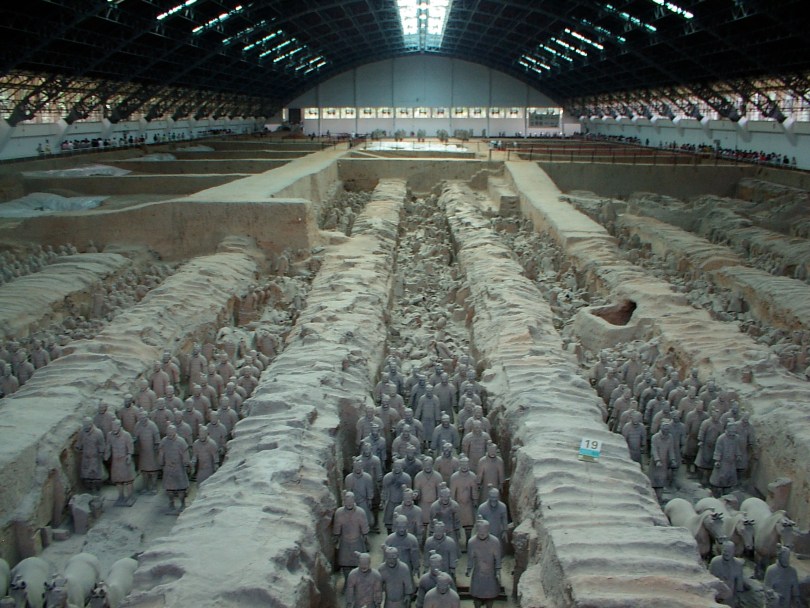
The archaeological site with the Terracotta Army or Bingmayong in Xi’an, China


Enjoying the sights and sounds of Xi’an, China, April 2009


Book a stay in China by clicking here.
*Unless otherwise specified, the copyright in all pictures belongs to nooranandchawla.
**This is not a sponsored post, but it contains an affiliate link. If you book a stay using my link, I’ll earn a small commission at no extra cost to you.
A for Amritsar, B for Bhopal, C for Cambodia, D for Delhi, E for England, F for France, G for Gwalior, H for Hemkund Sahib, I for Italy, J for Jim Corbett National Park, K for Kamakhya Devi Temple, L for London, M for Munich, N for Naples, O for Odisha, P for Prague, Q for Qila Mehrangarh Jodhpur, R for Rishikesh, S for Singapore, T for Tarifa in Spain, U for Udhampur in Jammu & Kashmir, V for Velassaru in Maldives, W for Westminster City in London